L'Islet (Summer)
Quebec regionChaudière-Appalaches
Excellent
L'Islet-sur-MerMusée maritime du QuébecL'Islet

L'Islet (Summer)

By Marilou Harvey••89 views

Nestled on the south shore of the St. Lawrence, between Montmagny and La Pocatière, the L'Islet regional county is one of the most discreet in Chaudière-Appalaches — and one of the most endearing. Its villages, strung along the chemin des Pionniers, unfold a remarkable built heritage, where stone houses and church steeples stand out against the horizon of the river.

But what truly sets this territory apart is its maritime heritage. L'Islet-sur-Mer proudly carries the nickname "Homeland of Sailors": generations of captains, pilots and navigators were born here, among them the legendary Joseph-Elzéar Bernier, a pioneer of Canadian polar expeditions. Here the river isn't a backdrop, it's a family story.

Barely an hour from Quebec City, the region lends itself wonderfully to a day trip: museums, tidal flats, sunsets over the St. Lawrence and that quiet sense of being in the right place.

Practical information

Duration
Une demie-journée
Season
Été
Getting around
Tesla
Accommodation
N-A

Itinerary

Chargement de la carte…
1
Québec
2
L'Islet-sur-Mer
3
Québec

L'Islet-sur-Mer

Musée maritime du Québec – Capitaine J.E. Bernier

Set on chemin des Pionniers Est, in L'Islet-sur-Mer, the Musée maritime du Québec is one of the finest museums in Chaudière-Appalaches — and probably the most surprising. Visiting it means plunging into the memory of the St. Lawrence, in a village that saw generations of sailors born.

The indoor visit unfolds over three levels and offers five exhibitions. The star is of course captain Joseph-Elzéar Bernier (1852-1934), a son of L'Islet, who was commanding ships by the age of 17 and who helped define Canada's Arctic boundary. The new permanent exhibition HIVERNAGE / UKIITILLUGU recounts his seven Arctic expeditions between 1904 and 1917, highlighting his encounters with the Inuit, whose ancestral knowledge proved vital to these sailors from the south. A sensitive and genuinely well-crafted exhibition.

Don't miss the model room either, accessible on a guided tour: more than 200 scale models of ships that marked the maritime history of Quebec and Canada. Breathtakingly fine work.

The two museum ships

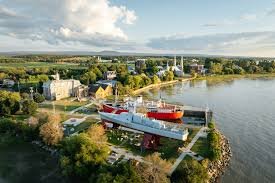
This is where the experience becomes truly unique: you step aboard two exceptional vessels, kept in dry dock just behind the museum.

The icebreaker CCGS Ernest Lapointe, a former flagship of the Canadian Coast Guard, sailed the St. Lawrence from 1940 to 1978. Over the winter of 1958-1959, it freed some sixty ships trapped in the ice between Montreal and Quebec City. You visit it on your own, from the engine room to the upper decks by way of the wheelhouse — children love taking the helm!

The other ship is downright surreal: HMCS Bras d'Or 400, a prototype military hydrofoil designed by the Royal Canadian Navy during the Cold War. In service from 1968 to 1971, it exceeded 63 knots (117 km/h) in hydrofoil mode during its sea trials, making it the fastest warship over 100 tonnes in the world. 

The riverside park and its open-air exhibition

The wharf has been completely redeveloped to offer families a broad space for play and discovery, with an entirely free open-air exhibition. You wander between the sentier des Hélices, the halte des Icebergs, the jardin des Encres, the pointe du Mât, the placette des Treuils and the place des Brumes — stations that invite you to touch, to climb and to look at the river differently.

Families can also pick up the passeport Aventure and set off on La quête Des-Trois-Lieux, with captain Bernier's challenges, the riddle of the Duhamel mast and the self-guided digital tour L'Équipée. A picnic area and a terrace round out the site, and parking is free right across the way.

Good to know: the ships are closed in the low season, so aim for the summer months to get the full experience. The site is also accessible to people with reduced mobility, with adapted services for hearing and visual impairments.

Highlights

  • •
    Musée maritime du Québec – Capitaine J.E. Bernier
  • •
    Brise-glace NGCC Ernest Lapointe
  • •
    Hydroptère NCSM Bras d'Or 400
  • •
    Chambre des maquettes
  • •
    Parc fluvial et exposition à ciel ouvert

Frequently asked questions

Where is the Musée maritime du Québec?
In L'Islet-sur-Mer, on chemin des Pionniers Est, in the L'Islet regional county, in Chaudière-Appalaches. It's on the south shore of the St. Lawrence, between Montmagny and La Pocatière, about an hour east of Quebec City. Careful not to confuse it with the Site historique maritime de la Pointe-au-Père, which is in Rimouski, in the Bas-Saint-Laurent.
Can you go aboard the ships?
Yes, and that's what makes the experience unique. Two vessels are kept in dry dock behind the museum. The icebreaker CCGS Ernest Lapointe can be visited on your own, from the engine room to the wheelhouse by way of the upper decks. The hydrofoil HMCS Bras d'Or 400, however, can only be seen on a guided tour, with sign-up at the front desk. The ships are closed in the low season.
Who was captain Joseph-Elzéar Bernier?
A son of L'Islet, born in 1852, who was commanding ships by the age of 17 and who helped define Canada's Arctic boundary. He led seven Arctic expeditions between 1904 and 1917. The permanent exhibition Hivernage / Ukiitillugu is devoted to them, highlighting his encounters with the Inuit, whose ancestral knowledge proved vital to these sailors from the south.
What is HMCS Bras d'Or 400?
A prototype military hydrofoil designed by the Royal Canadian Navy during the Cold War. In service from 1968 to 1971, it exceeded 63 knots, or 117 km/h, in hydrofoil mode during its sea trials, which made it the fastest warship over 100 tonnes in the world. It is named after Bras d'Or Lake, in Cape Breton.
What can you do for free on the site?
The riverside park and its open-air exhibition are entirely free, as is the parking right across the way. You wander between the sentier des Hélices, the halte des Icebergs, the jardin des Encres, the pointe du Mât, the placette des Treuils and the place des Brumes. A picnic area rounds out the site. It's our favourite part of the day, and it's outdoors.
Is the museum good for families?
Absolutely. Children love taking the helm in the icebreaker's wheelhouse. Families can also pick up the passeport Aventure and set off on La quête Des-Trois-Lieux, with captain Bernier's challenges, the riddle of the Duhamel mast and the self-guided digital tour L'Équipée. The wharf park has been completely redeveloped as a space for play and discovery.
How much time do you need for the visit?
Half a day is a good benchmark. The indoor visit unfolds over three levels with five exhibitions, and to that you add the two ships, the model room on a guided tour and the riverside park. If you want to do the hydrofoil, book your time slot as soon as you arrive at the front desk.
What is the model room?
A room accessible on a guided tour that gathers more than 200 scale models of ships that marked the maritime history of Quebec and Canada. It's fairly impressive, painstaking work, and one of the least known aspects of the museum. Ask at the front desk when you arrive.
Is the site accessible to people with reduced mobility?
Yes, the site is accessible, and adapted services are offered for hearing and visual impairments. Some areas of the historic ships remain hard to reach, though, because of their original layout, with ladders and narrow passages. Best to check at the front desk according to your needs.

Why is L'Islet nicknamed the Homeland of Sailors?
Because generations of captains, pilots and navigators were born here. Here the river isn't a backdrop, it's a family story. That maritime heritage can still be read in the villages strung along the chemin des Pionniers, with their stone houses and their steeples standing out against the horizon of the St. Lawrence.

Comments

Loading comments…

Around this place

35 m from Quebec City · 233 km from Montreal

See all our places on the map →